
CWS-CARES Public Library
The CWS-CARES Public Library is a searchable repository of project information. The articles published here may also be located in the CARES Explorer Newsletters. If you have any questions, please contact CWDS Communications.
Data and Interfaces
Iterative Design: How CWS-CARES Keeps Improving
Weekly system releases require downtime for the Prod Sim environment. To minimize impact to Organizations, Prod Sim is unavailable each Friday from 5:00 PM to Saturday by 12:00 PM PDT. During this window, users will be unable to access the environment or test workflows in Prod Sim.
System Updates and Fixes: July - September
County testing remains essential to a successful Go-Live. Validating converted data, practicing workflows, and reporting issues promptly allows the Project to catch defects early. Below is a month-by-month summary of fixes through September 2026. For more details on defect fixes, refer to the Weekly System Updates and Release Notes on the Production Simulation Hub.
- July: Corrected data mappings, fixed permissions, and helped required fields populate properly across Case Management, Document Generation (DocGen), Adoption workflows, Resource Family Approval (RFA), and Financial Management.
- August: Focused heavily on data conversion, improving the accuracy of converted case records across areas including address, adoption, case, child location and placement, health, and person data. Fixes also touched case management, placement, courts, and intake workflows.
- September: Introduced new email notifications, alerting users directly when assignments change, approvals are requested, tasks are assigned, or a portal account is activated. The RFA and FFPSA Portals also became available for testing, alongside continued data conversion corrections.
Ongoing Data Fixes Through November 2026
Prod Sim will continue receiving weekly code and data fixes through November 20. After that, the environment will remain available for access as the Project prepares for CWS-CARES V1 Go-Live on December 7, 2026. Data validation is critical through early November. This is the last structured window for counties to review converted case records against source systems and flag discrepancies before Prod Sim's final updates. We encourage all counties and Organizations to prioritize validation now to help ensure data is accurate at at Go-Live.
Feature Spotlight: Search Functionality Improvements
Search across CWS-CARES has also improved this summer. Person and Resource Management Directory searches now use "AND" logic instead of "OR," so each additional criterion narrows results rather than broadening them. Phonetic name search can help locate a record even when spelling is uncertain, and Sex at Birth and Approximate Age are now fully functional search criteria. Additional search enhancements are planned in upcoming releases. For a detailed guide on recent search enhancements and tips for utilizing this feature, see the CWS-CARES Search Functionality fact sheet on the CWDS website.
Defect Reporting
If you spot a potential defect and aren’t sure if it’s already logged, please submit a support ticket anyway or report the issue at Production Simulation Office Hours. We prefer to manage duplicate tickets than miss a critical defect.
Users may access the CWS-CARES Production Simulation Hub for resources, support, and regional office hours scheduling.
Originally published in the CWS-CARES Explorer.
CWS-CARES & Integration: Connecting Data Across Systems
Data is brought into CWS-CARES through ongoing data exchange, historical data conversion or both, depending on the system.
- Interfaces stay connected to CWS-CARES and exchange data on an ongoing basis. These include tools Organizations rely on for assessments, eligibility, court information, and facility licensing. This connection is a lasting link, not a one-time transfer.
- State reporting systems receive data from CWS-CARES to support reporting, performance monitoring, and outcomes tracking across California's child welfare system.
Originally published in the CWS-CARES Explorer.
Kin-GAP Demo Highlights the Link Between CWS-CARES & CalSAWS
Using the end-to-end Kin-GAP demonstration, the CWS-CARES EUST 3 Team created a Kin-GAP scenario for general testers, which CalSAWS then leveraged for their EUST 3 testers. The Kin-GAP scenario became available for EUST 3 testers on March 23, 2026, and was used throughout the remainder of the General Testing period. The Kin-GAP scenario, in addition to other EUST scenarios, will be provided to Production Simulation users as a training resource in May 2026. On April 15, 2026, CalSAWS also hosted a Kin-GAP demonstration.
Originally published in the CWS-CARES Explorer.
CWS/CMS Data Conversion Update & Timeline
Data Conversion is the process of bringing existing case information from CWS/CMS into CWS-CARES so counties can continue their work seamlessly when the new system goes live in October 2026. This work is done in close partnership with counties and other organizations to ensure information is carried over accurately and consistently.
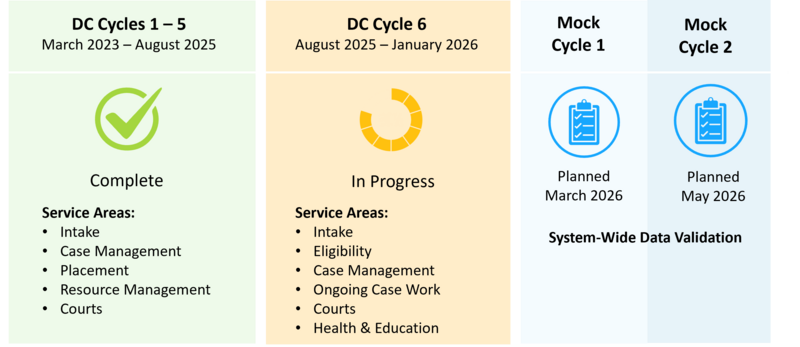
To support this effort, the Project is completing Data Conversion through six cycles, along with two full practice runs (mock cycles), to test and confirm that information moves correctly into CWS-CARES. This phased approach helps identify issues early and strengthens readiness for all counties.
As of December 2025, Data Conversion Cycles 1–5 are complete, and Cycle 6 is currently underway. A small group of county representatives volunteered to review converted information and share feedback, helping ensure the system is on track for Go-Live. Thank you to the counties and participants supporting this work—your involvement helps strengthen CWS-CARES for everyone.
Originally published in the CWS-CARES Explorer.
Staying Connected Statewide with P-CIS & CWS-CARES
What is P-CIS?
P-CIS is a Software as a Service (SaaS) platform designed to streamline workflow, integrate with multiple systems, and provide real-time access to assessments, analytics, and outcomes tracking. P-CIS allows different systems to work together, enabling secure and efficient data sharing, and eliminating duplicate data entry.
Signing on to P-CIS with SSO
Single Sign-On (SSO) is a convenient way to access multiple platforms using just one username and password. Once you sign in to CWS-CARES, SSO allows you to seamlessly access the P-CIS platform without needing to log in again.
Actionable Insights with Analytics
- Trajectory Graph - Visualize changes in needs and strengths over time, with options to toggle or combine categories.
- Story Map - Summarize needs and strengths with supporting context, ideal for Child and Family Team discussions.
- Item Detail - Review specific item scores and notes over time for a deeper understanding.
- Family Reports - Provide families with a clear summary of recent CANS scores and progress, custom built with CDSS and DHCS stakeholder input.
Sharing CANS for Enhanced Collaboration
The P-CIS/CWS-CARES interface enables sharing of Child and Adolescent Needs and Strengths (CANS) assessments among providers. Benefits of data sharing between agencies include:
- Integrated History: Historical CANS from CWS-CARES and Behavioral Health systems are consolidated within P-CIS.
- Real-Time Sharing: Behavioral Health agencies can share CANS with CDSS in P-CIS, enhancing coordination.
- Statewide Alignment: A unified approach ensures consistency across counties and partners.
CANS Assessment Features:
- Seamless integration of CWS-CARES, P-CIS, and County Behavioral Health agency platforms.
- Centralized data collection to streamline workflow, automate notifications and ratings.
- Longitudinal analysis to track consolidated CANS data to identify trends and inform updates.
- Workflow automation to improve documentation efficiency and compliance.
- Customizable security and consent management to enable controlled data sharing.
- Caregiver Tracking: Monitor caregivers’ progress over time to improve outcomes for children and families.
Outcomes for Communities Served
By integrating data across care organizations, P-CIS improves outcomes by:
- Greater care coordination among agencies and service providers.
- Faster and more informed decision-making based on real-time data.
- Enhanced transparency and accountability in case management.
- Better long-term outcomes for children and youth through data-driven interventions.
Originally published in the CWS-CARES Explorer.
Partnership in Action: Information and Document Sharing between CWS-CARES and CalSAWS
When a child is removed from their home and placed into Foster Care, CWS-CARES will create an Eligibility Record and initiate a case link to CalSAWS through the Foster Care Eligibility Determination (FCED) interface. The FCED interface allows information to be shared bi-directionally between CWS-CARES and CalSAWS to support the provision of Foster Care and Medi-Cal benefits.
CWS-CARES will provide the CalSAWS worker with information regarding the child’s return home or their transition to permanency through legal guardianship, adoption, or Extended Foster Care. This information will assist CalSAWS workers to continue to provide benefits to the child through programs such as Non-Related Legal Guardianship (AFDC-FC), Kinship Guardianship Assistance Program (Kin-GAP), or Extended Foster Care.
What information can be shared between CWS-CARES and CalSAWS?
CWS-CARES will provide information through the FCED interface to CalSAWS regarding placement changes, rate changes, Intercounty Transfers (ICTs) and more. CWS-CARES and CalSAWS workers can upload documents to be viewed and/or downloaded by the worker in the other system, such as birth certificates and court orders. In addition, CWS-CARES and CalSAWS workers will be able to use the FCED interface for limited messaging called Request for Information (RFI). This can be used to request information or documents from the worker in the other system, to advise that documents have been uploaded and are ready to view, or to share information.
Originally published in the CWS-CARES Explorer.
From Scope to Strategy: Preparing for External System Decommissioning
The scope assessment process helps identify external systems eligible for decommissioning when CARES V1 goes live and what preparations are needed. Decommissioning planning includes confirming a system has duplicative functionality, developing realistic steps and timelines to take the system off-line, identifying system dependencies, and ensuring business continuity throughout the transition. This work is the foundation for long-term planning and informed decision-making.
Counties will have opportunities to validate CARES V1 functionality, identify any gaps, and adjust their decommissioning plans based on Extended User Scenario Testing (EUST) validation, practice in the Sandbox Environment, and real-time use. Decisions will be finalized after validation confirms CARES V1 meets required functionality and operational needs. No systems will be required to be fully decommissioned at CARES V1 Go-Live in October 2026.
By approaching this work collaboratively and with clear validation checkpoints, we aim to support counties in creating decommissioning plans that are practical, phased, and aligned with both policy and operational needs. We’d like to thank all counties and organization partners for their ongoing collaboration on this effort!
For more information, please join us on Thursday, July 10th from 10 – 11 AM for the External Systems Monthly Meeting Kickoff! This online meeting series will be held on the second Thursday of each month.
Originally Published in the CWS-CARES Explorer.
State and County Forms in CWS-CARES
Goals and Objectives
A critical goal for CWS-CARES is making forms and documents efficient for workers to generate and manage, and to standardize statewide forms in one system. The CWS-CARES project understands that counties have their own custom forms and may have unique document generation requirements; CWS-CARES will support document generation for both Microsoft Word and Adobe Experience Manager (AEM) templates. Due to state requirements, all forms must adhere to the ADA guidelines as a development best practice.Training for Forms Authors
Training for County forms authors consists of self-paced training and hands-on virtual training sessions. Self-paced training covers 12 lessons that focus on understanding and building PDF forms. Hands-on training covers Document Generation Solution components, eSignature, Forms Workspace access, template design considerations and development, testing, migration, and deployment. Hands-On Training for Cohorts 2 and 3 is scheduled for July 2025. Training for Cohort 4 will begin in August 2025.
Improvements from CWS/CMS
In CWS/CMS, counties were limited to 200 forms. CWS-CARES does not have a limit on the number of forms that counties can build and make available to their county workers. County Forms Authors will be able to map data fields from CWS-CARES to forms so that data is automatically populated when the related document is generated by a worker. County Forms Authors will also be able to download any statewide form built in CWS-CARES, customize it for their county’s requirements, and save it for their workers to use.
Progress Updates
-
All counties have been given an inventory of their county specific forms which are available in CWS/CMS.
-
A tracker, ‘CARES Forms Tracker’ is available in the CARES Forms Workgroup Team(s) channel containing the state forms for CARES V1 development.
-
A Forms Workgroup was created to support counties with forms management. Please contact them at otsicwdscaresforms@otsi.ca.gov with questions.
- The Project has provisioned a new environment specifically to support county forms development activities.
Originally Published in the CWS-CARES Explorer.
The CWS-CARES Data Dictionary: Update and Resources
Definitions
The CWS-CARES Data Dictionary and Entity Relationship Diagrams (ERDs) are designed to assist counties and other data partners in understanding the structure, purpose, and use of data within CWS-CARES.The Data Dictionary is a reference guide that explains the structure and meaning of data in CWS-CARES system, such as database fields, types, and relationships, ensuring consistency and clarity.
Entity Relationship Diagrams (ERDs) are a visual representation of how different data elements are related within CWS-CARES system, helping to design and understand databases.
Evolution of the Data Dictionary
The initial version of the CWS-CARES Data Dictionary and legacy mapping of CWS/CMS fields is now available. This version reflects the current state of CWS-CARES. As CWS-CARES continues to evolve and improve over the coming months, this initial version will be updated to incorporate new changes.The CWS-CARES Project conducted a walkthrough of the initial version of the CWS-CARES Data Dictionary and related materials with county representatives and data partners in March 2025. A recording of the walkthrough is available in the CWS-CARES Data Dictionary Microsoft Teams channel.
Publication and Ongoing Updates
A dedicated Microsoft Teams channel has been created for all CWS-CARES Data Dictionary-related materials. Contact CWDSDataManagement@osi.ca.gov to request access to the Microsoft Teams Channel called CWS-CARES Data Dictionary. Questions can be submitted directly to the CWS-CARES Technology team's inbox: CWDSDataManagement@osi.ca.gov.Future iterations of the Data Dictionary will be published quarterly to provide greater clarity, address gaps, and potentially modify or remove certain fields or rename them. We appreciate your patience and understanding as we work diligently to ensure the successful implementation and ongoing maintenance of the CWS-CARES Data Dictionary.
Originally published in the CWS-CARES Explorer.
Interfaces in CARES V1
CARES V1 will include the following interfaces: