
CWS-CARES Public Library
The CWS-CARES Public Library is a searchable repository of project information. The articles published here may also be located in the CARES Explorer Newsletters. If you have any questions, please contact CWDS Communications.
Data and Interfaces
JNET Interface
We are pleased to share that the JNET interface for CWS-CARES is now completed ahead of schedule!
JNET is used to track children, youth, and young adults involved in the juvenile justice system, whether as probation wards or child welfare dependents.
The JNET interface is currently in use with CWS/CMS. The interface is being kept in place for CARES V1 at the request of San Bernardino County. The functionality in CARES V1 will be identical to the existing functionality in CWS/CMS. The interface will update the courts system with current assignments in CWS-CARES that applies to San Bernardino only.
Originally published in the CWS-CARES Explorer.
Data Conversion: How Counties are Participating
The Data Conversion Team has been working to convert data from CWS/CMS to CWS-CARES. To accurately capture the questions and needs of our counties, the Data Conversion Team has a process that they repeat every Data Conversion Cycle with new and existing groups for Practice and Data Validation (depending on service areas).
First, they schedule a kickoff meeting to provide a general overview of the data conversion process so that the counties know what to expect. For Practice Validation, the workgroup meets regularly to discuss the source to target mapping (STTM) and transformation logic for the original field in the legacy system and the new field in CARES V1. For Data Validation, office hours are scheduled to answer questions and walk through issues reported by the county testers.
The Data Conversion team tracks and addresses issues brought up by the counties, and revises STTM and/or transformation logic as needed. When functionality questions come up, the team also creates clarification requests and follows up with the Product team. All the responses and updates to issues raised are accessible real-time via Microsoft Teams.
We want to thank counties for their continued support in this critical process of validating data conversion!
Originally published in the CWS-CARES Explorer.Structured Decision Making (SDM) Interface
- Hotline Assessments at Intake
- Both Safety and Risk Assessments (in home, substitute, and congregate care provider) during Investigations
- Reunification/Risk Reassessment in Case Management
Originally published in the CWS-CARES Explorer.
Moving Historical Data into CARES V1
Milestone Design
- Identify which elements from CWS/CMS, CARES-LIVE, and selected external systems should be converted.
- Address any data quality concerns (e.g., incomplete or incompatible records) for the elements being converted.
- Transfer the historical data to a data conversion staging area within CDI, and test to make sure everything transferred as expected.
- Transfer the historical data from the staging area to CARES V1, and test to make sure everything transferred as expected.
Originally published in the CWS-CARES Explorer.
CWS-CARES Interface with CalSAWS
When a child has been placed in a foster home, forms have to be completed and sent manually to CalSAWS. Staff might call, fax, or email information and wait for a response. The foster family might not receive timely payments due to delays in processing.
In the future, the FCED interface will allow data to be sent and received quickly with a near real-time exchange of information. It enables an eligibility determination to be performed with a click of a button, and eliminates duplicate data entry in different systems thus reducing the chance of typos or inconsistencies. Staff will receive a notification when the determination is complete.
The FCED interface reduces the burden of users needing to re-enter the same information in both CWS-CARES and CalSAWS with new automation. Paper forms will also be automated through FCED. This facilitates secure and efficient information sharing between different agencies and departments involved in child welfare cases. Automating tasks like eligibility validation and benefit calculations can reduce the administrative burden on workers.
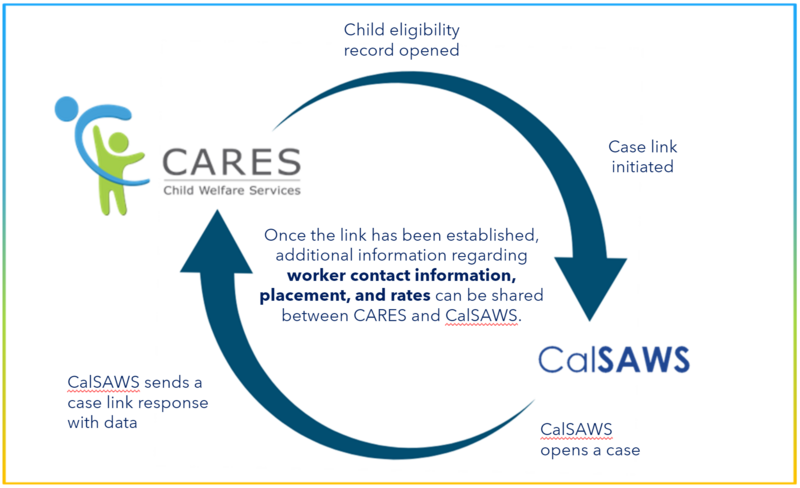
This back-and-forth data exchange through FCED allows CWS-CARES and CalSAWS to share information. This is just one of the many interfaces that CWS-CARES is building to transform child welfare services in California.
Originally published in the CWS-CARES Explorer.
Documents are moving from an old house (CWS/CMS) to a new house (CWS-CARES)
The benefits of moving documents to CWS-CARES include the following:
CWS-CARES is like a spacious, modern house. There's plenty of room for everything (data) and the layout is designed for efficiency (optimized workflows).
Over 72 million existing CWS/CMS documents from the last 25+ years were uploaded from CWS/CMS mainframe format and converted into compatible documents for CWS-CARES (e.g., doc, jpg, pdf, and xls formats).
The new CWS-CARES “house” will include features that the old one didn't, such as improved security. We scanned all the documents against viruses and malware during conversion and security is enforced in the CARES application and infrastructure.
Moving documents from CWS/CMS to CWS-CARES provides an opportunity to archive irrelevant information, freeing up storage space and improving data accuracy.
Until CWS-CARES launches in 2026, documents will continue to be uploaded to CWS/CMS every minute! We convert approximately 100,000 documents from CWS/CMS to CWS-CARES on a weekly basis.
Migrating documents is a long and complex process, and we’ve been working on this since September 2022. Thank you to the County IT and Data SMEs who have been participating in data activities. Their continuous efforts and participation have been essential to data migration success. We extend our gratitude to every member of the County IT/Security, CWS-CARES Data Conversion and Data Infrastructure teams.
Originally published in the CWS-CARES Explorer.
- ← Previous
- 1
- 2
- Next →