
CWS-CARES Public Library
The CWS-CARES Public Library is a searchable repository of project information. The articles published here may also be located in the CARES Explorer Newsletters. If you have any questions, please contact CWDS Communications.
Product Features
SafeMeasures® and SDM® Assessments in CWS-CARES: An Update From Evident Change
SafeMeasures
Since July 2026, the California SafeMeasures core team and Evident Change have been working to create SafeMeasures reports in CWS-CARES using Production Simulation (Prod Sim) data. The focus is on easy navigation, access to frequently used reports, and an improved user experience that includes improved accessibility.
SDM Assessments
Training on SDM in CWS-CARES is now available through several formats:
- Instructor-Led Training (ILTs): SDM assessments are included in the ILTs, with a dedicated SDM training environment for hands-on practice during those sessions.
- On-Demand Training Videos: Sessions are broken down by SDM assessment type, including content specifically for supervisors, so staff can learn on their own schedule.
- Production Simulation: Staff can practice SDM workflows using data from real families, with no impact on live CWS-CARES data or cases. Practice scenarios are available to help staff understand the new integration workflows.
No WebSDM data will be lost. All completed and approved assessments in WebSDM will be imported into CWS-CARES as PDFs and housed within case records. Incomplete assessments will not be imported. User administration, previously managed through WebSDM, will move to CWS-CARES permissions. All training will take place in the CWS-CARES training environment (CARES 104) going forward.
For practice-related questions about SDM assessments in CWS-CARES, contact Evident Change. Evident Change’s social service practice team is ready to support staff as they train, learn, and use SDM in CWS-CARES.
Originally published in the CWS-CARES Explorer.
Forms and Reports: Preparing for Go-Live and Beyond
Which Forms and Reports will be developed by the project?
Check the CARES Forms Tracker on the CARES Forms Workgroup Microsoft Teams Channel for the current list of state forms slated for CARES Version 1 (V1) development by the project. Please note, additional state forms not currently listed on the CARES Forms Tracker will be created by the project after CARES V1 Go- Live. The project, in partnership with CDSS, will identify additional forms for project development, and updates will be shared as this work progresses.Will state forms built by the project be up to date?
The project will use the most current guidance available from CDSS and the Judicial Council to build each form by CWS-CARES Go-Live. If a state form is updated after it has been built, those changes will be queued and applied on an ongoing basis post Go-Live.Originally published in the CWS-CARES Explorer.
CWS-CARES Sandbox Opens to First Group of Users!
To prepare for their Sandbox journey, new Sandbox users attended an orientation session to learn about the Sandbox user access process, functionality and data available in the system, and the support provided for users. New users attended a training session to learn how to access and complete the on-demand training programs within the Sandbox environment. Drop-in Office Hours are available twice a day to provide support and troubleshooting as Sandbox users continue to explore and build familiarity with the system.
Up Next: Adding More Sandbox Users
This first cohort of Sandbox users is broken into three groups, beginning with the first group of users from organizations whose connectivity to CWS-CARES was established when they participated in EUST. Six additional organizations make up Cohort 1, Group 2, which began onboarding into the Sandbox in mid-September 2025. Cohort 1, Group 3, the remaining organizations, will onboard in October.The project will continue to onboard new cohorts of users into the Sandbox throughout 2025 and into Spring 2026. Cohort 1 users will fill a vital role in supporting their organization’s future Sandbox users by setting up internal support structures, sharing best practices, and serving as go-to resources for questions and troubleshooting.
Implementation Coordinator(s) and Single Point(s) of Contact at each organization select Sandbox users for each cohort. If you’re interested in joining the CWS-CARES Sandbox, please reach out to your organization’s Implementation Coordinator(s) and Single Point(s) of Contact.
“When people in my organization have questions about CARES, it's really helpful to log into the Sandbox and show them what it looks like.”
– CWS-CARES Sandbox User
Sandbox Onboarding Timeline
July – October 2025
Cohort 1
Group 1: Mid-July 2025
30 Organizations that established connectivity during previous Extended User Scenario Testing
Group 2: Mid-September 2025
6 additional Organizations able to establish early connectivity
Group 3: October 2025
All remaining Organizations
October 2025
Cohort 2: Additional members from each organization
January 2026
Cohort 3: Additional members from each organization
April 2026
Cohort 4: Additional members from each organization
Hands-On with CWS-CARES: Upcoming Testing Periods
The CWS-CARES Project has several important user testing activities scheduled over the coming months. These testing periods allow organizations to engage directly with the system, provide feedback on its design, and help ensure readiness for CWS-CARES Version 1 (V1) Go-Live.
Usability Testing: October – December 2025
The Project will conduct two Usability Testing Periods prior to Extended User Scenario Testing (EUST) 3. These sessions invite a limited group of Core Constituent counties who were engaged in EUST 2 and confirmed participants in EUST 3 to complete defined tasks in specific areas of CWS-CARES. The goal is to gather early input on functionality, evaluate usability, and address issues before moving into broader end-to-end testing.
EUST 3: February – April 2026
Following the usability testing rounds, organizations are invited to participate in EUST 3, scheduled for February 2 – April 3, 2026.
EUST 3 takes a holistic approach, asking participants to complete real-world, end-to-end scenarios that span multiple areas of the system—from Screening and Intake to Forms. This broader view builds on the focused usability testing and provides a comprehensive assessment of system readiness ahead of CWS-CARES V1 Go-Live.
Support for Participants
Counties participating in testing will receive support through kickoff sessions, optional office hours, and connectivity guidance to ensure access to the CWS-CARES staging environment. Feedback will be collected directly from testers as they complete their assigned tasks. Together, the Usability Testing Periods and EUST 3 create a structured path toward CWS-CARES V1, ensuring the system is ready for successful statewide use. For questions, please contact the CWS-CARES EUST Mailbox.
Testing Timeline
Usability Testing Period 1: October 27 - November 7, 2025
Scope: Screening/Intake, Referral/Placement, Risk/Safety Assessment, Person Profile, Plan of Safe Care, 90-Day Transition Plan
Usability Testing Period 2: December 8 - December 19, 2025
Scope: Adoption & After Care & Re-Entry (Finish a Case), Forms
EUST 3: February 2 - April 3, 2026
Scope: All service areas in Usability Testing Periods 1 & 2, validation of previously testing functionalities within CWS-CARES, State and Federal reporting, and CWS-CARES Administration Console
Originally published in the CWS-CARES Explorer.
How Changes to Optimistic Concurrency Elevate Real-Time Teamwork
What happens when multiple users make edits to the same case at the same time in CWS-CARES?
One of the many improvements in the new CWS-CARES system is how it handles concurrency—that is, when multiple users are working on the same case at the same time. In the CWS/CMS system, Optimistic Concurrency (OC) is a major challenge: if two people open the same case and make updates, one person’s changes could be lost even if they both save their work. This happens because the system was built on technology that does not allow for real-time collaboration. CWS-CARES alleviates this concern. It’s built on modern, cloud-based technology where updates are completed in real-time. In CWS-CARES, multiple users work on different parts of the same case at the same time — with less likelihood to run into concurrency errors.
Even in the rare case where two users try to edit the exact same piece of information at the exact same time, CWS-CARES handles it the same way most modern systems do. If the system detects a conflict where a user might overwrite another user’s changes without reviewing them, it alerts the second user with an error message indicating that there was a conflict and temporarily retains their changes on the screen. The second user can then refresh to get the latest data, review it before re-entering their changes, and then save again. While the second user’s input is preserved temporarily on the screen, they will need to enter their changes again after the screen refresh to ensure data integrity.
Overall, CWS-CARES reduces optimistic concurrency issues, making it easier for teams to collaborate in real time. It helps avoid delays, protects everyone’s work, and supports a smoother, more efficient workflow.
Originally published in the CWS-CARES Explorer.
State and County Forms in CWS-CARES
Goals and Objectives
A critical goal for CWS-CARES is making forms and documents efficient for workers to generate and manage, and to standardize statewide forms in one system. The CWS-CARES project understands that counties have their own custom forms and may have unique document generation requirements; CWS-CARES will support document generation for both Microsoft Word and Adobe Experience Manager (AEM) templates. Due to state requirements, all forms must adhere to the ADA guidelines as a development best practice.Training for Forms Authors
Training for County forms authors consists of self-paced training and hands-on virtual training sessions. Self-paced training covers 12 lessons that focus on understanding and building PDF forms. Hands-on training covers Document Generation Solution components, eSignature, Forms Workspace access, template design considerations and development, testing, migration, and deployment. Hands-On Training for Cohorts 2 and 3 is scheduled for July 2025. Training for Cohort 4 will begin in August 2025.
Improvements from CWS/CMS
In CWS/CMS, counties were limited to 200 forms. CWS-CARES does not have a limit on the number of forms that counties can build and make available to their county workers. County Forms Authors will be able to map data fields from CWS-CARES to forms so that data is automatically populated when the related document is generated by a worker. County Forms Authors will also be able to download any statewide form built in CWS-CARES, customize it for their county’s requirements, and save it for their workers to use.
Progress Updates
-
All counties have been given an inventory of their county specific forms which are available in CWS/CMS.
-
A tracker, ‘CARES Forms Tracker’ is available in the CARES Forms Workgroup Team(s) channel containing the state forms for CARES V1 development.
-
A Forms Workgroup was created to support counties with forms management. Please contact them at otsicwdscaresforms@otsi.ca.gov with questions.
- The Project has provisioned a new environment specifically to support county forms development activities.
Originally Published in the CWS-CARES Explorer.
The Court Hearing Framework: What's New in CWS-CARES?
In CWS-CARES, the Court Record section will house all court work items, hearings, hearing outcomes, and active and closed cases. CWS-CARES will also facilitate the preparation and automation of documents and reports to ensure timely delivery. CARES Version 1 will include the following functionality in the Court Record:
Petitions
Petitions under WIC 300, 342, and 387, which pertain to removal and custody of children through the Dependency Court, can be created in CWS-CARES. WIC 388 petitions, Request to Change Court Order, will also be available. Petition allegations and counts will now be available for selection and the appropriate JV forms (120 – 129) will then auto generate based on the allegations in the petition. Petition statuses will also be tracked and modified once ruled on by the court to create the final petition.
Hearings
Hearing types, dates, and times will be documented in CWS-CARES, as well as the status of each hearing. As hearing dates are entered, noticing guidelines, timeframes, and details will be automatically generated in CWS-CARES, per WIC codes, for each hearing type.
Court Reports
Court Reports will look familiar; they are patterned after the INI templates used in CWS/CMS. Each county will be able to select the template that meets their court’s requirements and make alterations if needed. Unlike CWS/CMS, Court Reports can be created using Adobe (AEM) or Word, using prepopulated information from CWS-CARES. To create the Hearing Packet, users will have the ability to merge any documents, such as Case Plans, Service Provider Reports and/or other documents, with the Court Report. Electronic signatures will be available in CWS-CARES to make document signing more efficient for case workers.
Warrants (New!)
Each County will be able to upload their own Warrant templates into CWS-CARES to comply with their practice and court preferences. Later updates of CWS-CARES may include an interface that supports sending and receiving Warrants in the system, along with many other court work items and documents.
Discovery Requests (New!)
Discovery requests can be easily processed and documented in CWS-CARES. The documents selected for the request can now be merged into a PDF and automatically stored in the system. The status of the Discovery Request can be tracked or assigned to another user. Once complete, the Discovery documents can be provided to parties via secure email, hard copy or flash drive, based on County policy.
Court Officer Notes (New!)
Documenting important case information has never been easier; child welfare workers will now be able to immediately enter the court’s findings and orders in the Court Officer Notes section. These notes can be entered in the Hearing Results section of CWS-CARES and emailed to relevant parties (social worker, supervisor, eligibility). A signed copy of the Minute Order can also be uploaded into the system for easy reference once it is available.
Confidential Client Attorney Contacts (New!)
Confidential Client Attorney Contacts is a new feature in CARES V1. It will allow consultations between staff and County Counsel to be documented in a secure contact that, due to their legally confidential nature, will not be subject to discovery requests or any type of records request. They will only be viewable by those assigned to the case, the supervisor, and the manager.
Originally Published in the CWS-CARES Explorer.
Insights from CalSAWS and CWS-CARES Testing
We're pleased to share some key takeaways and progress from our recent EUST 2 efforts involving the CalSAWS and CWS-CARES interface, called Foster Care Eligibility Determination (FCED).
It's encouraging to report that many testers successfully replicated the core functionality of the interface, establishing case links and exchanging data and documents effectively. A significant achievement was the observed real-time data exchange between the systems. This demonstrates the responsiveness and efficiency of the current integration. We truly value all feedback received, as it indicates that we are providing a functioning product for our users to interact with and evaluate. We acknowledge that some users experienced initial login difficulties during the first few days of testing. We have addressed these issues and are continuously working to ensure a seamless user experience.
Testers gave important feedback about how the CalSAWS test scripts and instructions needed to better match those for CWS-CARES EUST 2. To address this, we are committed to closer collaboration with CalSAWS during scenario preparation and will conduct thorough reviews of CalSAWS steps to ensure better synchronization.
In response to testers' requests for increased visibility into CalSAWS processes and steps, we are exploring opportunities for CWS-CARES testers to attend CalSAWS kickoffs and training sessions, and vice versa. We are also considering integrating relevant CalSAWS scenario materials into our CWS-CARES materials to provide a more comprehensive view.
Based on the feedback received in EUST 2, a new requirement was identified for the Eligibility Resource area. We learned that clearer error messaging is needed to notify users of any data fields that are incomplete before submitting to CalSAWS.
Eligibility testers said they need to better understand what happens in CalSAWS after data is sent from CWS-CARES. Additionally, testers expressed challenges in understanding the technical error messages received. To improve user experience, we're making it easier to see what's happening behind the scenes and understand error messages. We are actively implementing this enhancement prior to V1 Go-Live.
This collaborative testing effort with CalSAWS has provided valuable insights, and we are committed to acting on this feedback to further refine and strengthen the integration between our systems. We appreciate the valuable feedback from our EUST 2 testers and remain dedicated to continuous improvement.
Interested in learning more about FCED?
On June 3, 2025 the project hosted an Introduction to FCED for Counties webinar. The session provided county staff with a foundational overview of FCED in CWS-CARES, covering the Who, What, When, Why, and How of the foster care eligibility determination process. The webinar also included a detailed demonstration of FCED functionality and live Q&A. For those who couldn’t attend, a recording of the session is available on the CWDS website.
Stay tuned for more learning opportunities as we continue to roll out FCED support. Thank you to everyone who attended the session!
Your Feedback in Action: EUST 2 Summary
Thanks to the valuable feedback we received from Extended User Feedback Testing (EUST) 2 participants, the CWS-CARES team is making updates to improve the system experience. Below is a summary of what we heard and how your input is driving changes.
From March 24 to April 18, 2025, the CWS-CARES project held its second round of EUST with 198 staff from 25 counties and CDSS participating. This critical effort provided the opportunity to test real-world scenarios and provide feedback on key system areas including Case Management, Resource Management, Eligibility, and Courts.
Compared to EUST 1, EUST 2 saw a significant increase in participation and feedback – 198 testers submitted 977 feedback items, up from 51 testers and 330 raw feedback items in EUST 1.
What's Next?
A feedback summary report was shared with all EUST 2 participants on May 14, 2025. The CWS-CARES team is now incorporating high-priority feedback. Looking ahead, the project is preparing for the next round of feedback:
-
EUST 3R – January 2026
- EUST 3 – February 2026
Specific dates for the next testing period will be shared in the coming months. We thank all EUST 2 participants for their thoughtful contributions. Your feedback is shaping a better, more effective CWS-CARES for everyone.
Feedback Highlights and Themes
CWS-CARES Feedback:
The chart below shows how feedback was distributed across the service areas. Case Management received the most input, followed by Courts, Eligibility, and Resource Management.
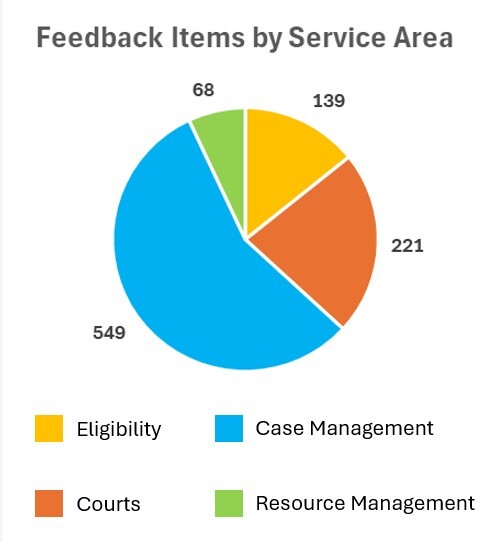
Testers shared positive impressions of the system’s improved design, ease of use, and overall user experience. Of the 977 feedback items received, 33 resulted in new functional requirements for development into CWS-CARES.
EUST 2 Process Feedback:
Support resources – such as training videos, the feedback site, check-in meetings, and office hours – were cited as helpful. Participants also identified opportunities for improvement:
-
Clearer, more detailed instructions
-
Better alignment and coordination with CalSAWS
-
More targeted training for new users
These suggestions are being used to improve materials and prepare for future testing efforts. Please contact the EUST team at careseust@otsi.ca.gov for more information about system and process feedback.
Originally Published in the CWS-CARES Explorer.
CWS-CARES Stakeholder Briefing Series (January 2025 Recap)
Stakeholder Briefing #2: January 2025
Stakeholder Briefing sessions are pivotal to keep counties, tribes, and partner organizations informed on the CWS-CARES project. The second Stakeholder Briefing Session was held on January 29, 2025. There were 557 virtual attendees for this session – the largest recorded participation rate to date. 52 counties, 13 county probation offices, and 1 tribal community were represented. During the session, participants had an opportunity to ask questions to Subject Matter Experts (SMEs) and view CWS-CARES feature highlights and demonstrations. This session, SMEs answered 137 stakeholder questions. Session materials and future dates are posted on the CWDS Website.At the end of the January briefing, participants completed an anonymous survey to share their experience. The results of the survey included the following findings:
- A total of 183 complete responses were collected in January.
- 88% of respondents felt satisfied or very satisfied with the Stakeholder Briefing.
- 94% felt that the information presented was either somewhat clear or very clear.
- 89% felt that the information presented was helpful or very helpful in understanding CWS-CARES.
Product Highlights and Demonstrations
During the January Stakeholder Briefing, teams showcased some of the changes that have been made as a result of core constituent feedback. This session included recorded demonstrations of Screening and Investigations, and feature highlights (screenshots) on Case Management and Foster Care Eligibility Determination (FCED).Screening Demonstration
- Updated Design Templates & Label Updates
- Safely Surrendered Baby Pathway
- Provisional Harm and Provisional Danger Statements
- Unknown Person Name Generator
- Address updates
- Structured Decision Making (SDM) Hotline Tool Interface
- Cross Reports to RFA & SCAR
- Evaluate Out & Community Resources
- Supervisor Response Type Override
- Person Relationship Builder
- Fatality/Near Fatality Documentation with Critical Incident Unit Notification
- Cross Report – CACI Documentation & Form Generation
- Case Type Differentiation
- Family Transfer Summary
- Removal & New Child Location
- Placement Needs
- Submit data to CalSAWS, Case Link Request
- CalSAWS worker views: Foster Care Case is linked
- Data exchange between CARES and CalSAWS